

An HMRC nudge letter about cryptocurrency is a standardised letter telling you that HMRC believes you may hold or have disposed of crypto assets. It is not an accusation. It is not a formal enquiry. It does not carry an automatic penalty.
Since 2020, HMRC has sent nudge letters to tens of thousands of suspected crypto holders, generated from data received through exchange reporting agreements. Receiving one means HMRC's data matched your name to a crypto platform. It does not mean HMRC has found an error in your tax affairs.
That distinction matters, because how you respond over the following weeks determines whether this stays a low-stakes letter or escalates into something far more serious. This guide walks through exactly what to do, phase by phase, from the moment the letter lands to closing the matter properly.
.png)
The instinct on receiving any HMRC letter is either panic or dismissal. Neither serves you well. The first phase is simply understanding what the letter is asking, and what it isn't.
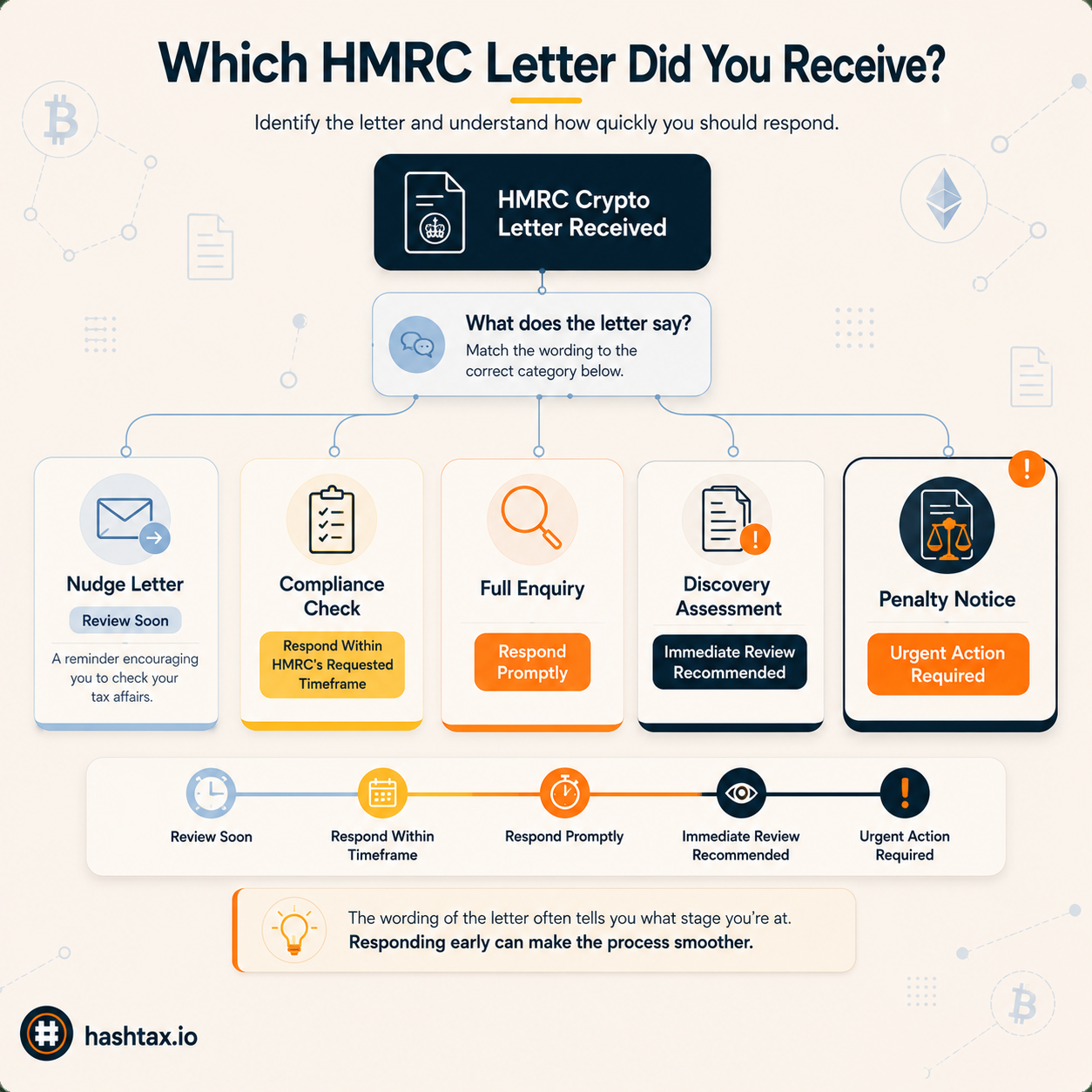
Step 1: Confirm the letter type. Nudge letters use general language such as "you may have cryptoasset transactions to declare." They do not name specific transactions, request specific documents by a fixed deadline, or reference a formal investigation power. If the letter does any of those things, you're likely looking at a compliance check or enquiry notice rather than a nudge letter, and the process below moves faster.
Step 2: Note there is no formal deadline, but don't treat that as an invitation to ignore it. A nudge letter creates a paper trail showing HMRC contacted you. If HMRC later discovers unreported crypto activity, having received and ignored this letter works against you when penalties are calculated.
Step 3: Resist the urge to reply immediately. A rushed response, sent before you've reviewed your own records, risks stating something inaccurate. HMRC's penalty framework treats an inaccurate statement made in response to a direct query more seriously than an honest gap discovered through your own review.
The table below shows how nudge letters compare to more serious HMRC contact, so you can confirm which category applies to you.
Before you can respond accurately, you need to know where you actually stand. This phase is about finding out, not guessing.
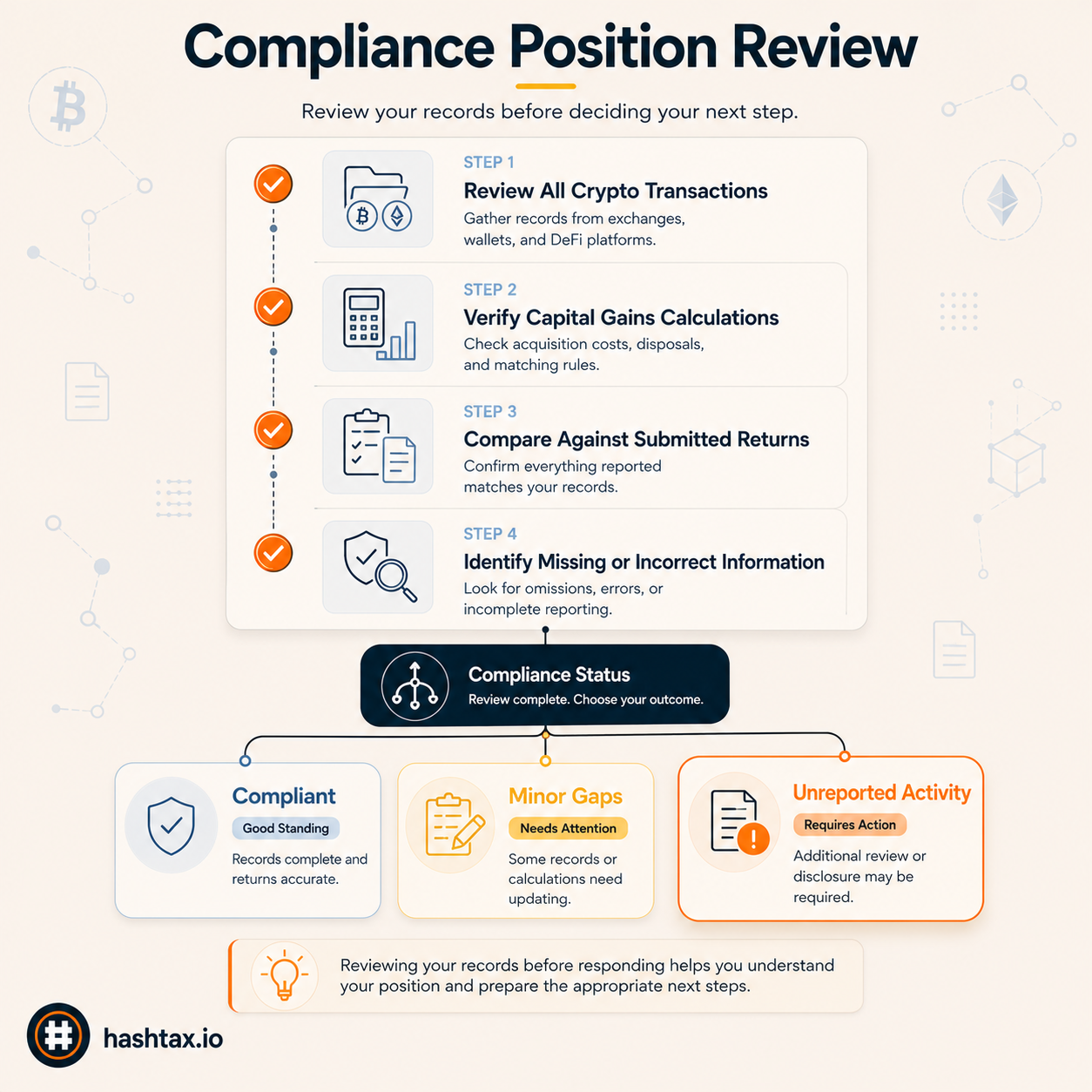
Step 1: Pull your full transaction history. Export data from every exchange and wallet you've used, covering every tax year you've held crypto. Nudge letters commonly arrive years after the activity in question, so don't limit this to the current tax year.
Step 2: Identify every disposal. Remember that disposals include selling for pounds, crypto-to-crypto swaps, spending crypto on goods or services, and gifting crypto to anyone other than a spouse or civil partner. Investors frequently underestimate this list, particularly the swap and spending categories.
Step 3: Compare disposals against what you've actually reported. For each tax year, check whether your Self Assessment return included a Capital Gains Tax summary reflecting your crypto disposals, and whether any income from staking, mining, or airdrops was declared.
Step 4: Categorise your position honestly. You'll land in one of three categories: fully compliant with nothing outstanding, compliant with minor gaps that need correcting, or holding unreported activity across one or more tax years. Each category has a different correct response, covered in the next phase.
This is the phase where most people either rush or stall. Rushing produces an inaccurate response. Stalling turns a manageable letter into a longer-running problem. A structured review, even a few focused hours, resolves both risks.
Your response depends entirely on what Phase 2 revealed. Getting this choice right protects you; getting it wrong creates new risk.
If you're genuinely compliant: A simple, factual response is sufficient. State that you've reviewed your crypto tax position and are satisfied it has been reported correctly. Keep a copy of what you send, and don't add speculative detail HMRC hasn't asked for.
If you have minor, honest gaps: These are typically small omissions such as a missed staking reward or an incorrectly valued disposal. Correct these through an amended return where the tax year allows it, or flag the correction directly in your response, depending on how recent the gap is.
If you have unreported activity: This is the scenario where the letter is doing you a favour. HMRC's voluntary disclosure route, the Digital Disclosure Service, exists specifically for this situation, and using it before HMRC opens a formal enquiry consistently produces a more favourable penalty outcome than waiting to be caught.
Penalty outcomes hinge heavily on behaviour, not just the underlying tax owed. HMRC categorises errors across three tiers, shown below.
Never respond by stating you are fully compliant if you know that isn't accurate. A false statement made in writing to HMRC after receiving a direct nudge letter moves your position from careless to deliberate, pushing you into a materially higher penalty band.
.png)
The final phase is execution. What this looks like differs depending on which path Phase 3 identified.
For a straightforward compliant response: Send a brief, factual letter confirming your reviewed position. Keep it short. Retain a copy and proof of postage or a tracked delivery confirmation.
For a voluntary disclosure: Registering for the Digital Disclosure Service starts a formal process with its own structure and timeline.
Interest on unpaid tax runs from the original due date, not from when you disclose, so the earlier a genuine gap is corrected, the smaller the interest component becomes. Delay does not reduce what's owed; it only adds to it.

Resolving the immediate letter is only half the task. The second half is making sure a future letter, if one ever arrives, finds nothing to flag.
Keep a running transaction log across every exchange and wallet you use, updated as trades happen rather than reconstructed annually. File your Self Assessment return with complete crypto disposal detail every year, not just in years with large gains.
Review your position each tax year before the 31 January filing deadline, giving yourself time to spot and correct gaps before they compound. HMRC's data-sharing arrangements with exchanges continue to expand, and from 2026 the Cryptoasset Reporting Framework introduces automatic international exchange reporting, meaning the visibility HMRC has into crypto activity will only increase from here.
Treat this nudge letter as the useful early warning it is, rather than a one-off problem to close and forget.
All our work is delivered by qualified specialists. We are not an automated software platform. Every response we prepare, whether a straightforward compliance confirmation or a full voluntary disclosure, is built by a specialist reviewing your actual transaction history.
Not sure which path applies to your letter? Start with the free Crypto Tax Health Check, or book a consultation to talk through your letter directly with a specialist.
Free Compliance Assessment
Our Crypto Tax Health Check reviews your trading history and flags whether your position is likely to need correction before you respond to HMRC. It takes about two minutes and there's no obligation to proceed further.
Three Paths Forward
Why Acting Now Matters
A nudge letter is the lowest-stakes contact HMRC ever sends. Every stage beyond it, from compliance check to full enquiry, carries higher penalties, more scrutiny, and less room to negotiate a favourable outcome. Interest also continues accruing on any unpaid tax for as long as it remains outstanding.
Get in Touch
Learn more about how we work on the HashTax homepage, or book your free consultation today. Your crypto tax compliance matters. Let's address it properly together.
Disclaimer: This article provides general information about UK cryptocurrency tax treatment and HMRC's nudge letter process, current as of the 2025/26 tax year. Penalty ranges, disclosure processes, and HMRC guidance are subject to change, and individual circumstances vary significantly. You should seek professional advice specific to your situation before responding to any HMRC correspondence. HashTax provides professional cryptocurrency tax services delivered by qualified specialists. We are not an automated software platform.
HashTax Specialists
Our team of ACCA-qualified accountants specializing in UK cryptocurrency taxation. We provide expert guidance on HMRC compliance, tax planning, and professional advisory services for crypto investors and businesses.

.svg)
.svg)