

A huge number of UK crypto investors believe tax only applies when they convert crypto back into pounds sterling. Swapping Bitcoin for Ethereum feels like staying "inside" the crypto ecosystem, so it feels invisible to HMRC.
That belief is wrong, and it's one of the most common, and costly, misunderstandings in UK crypto tax.
HMRC treats a crypto-to-crypto swap exactly the same way it treats selling crypto for cash. Both are disposals for Capital Gains Tax purposes. The moment you exchange one token for another, you've triggered a taxable event, whether or not any pounds ever touched your bank account.
This guide walks through the three mistakes that most commonly trip up swap-heavy portfolios, why each one creates real compliance risk, and how to correct course before HMRC's nudge letters or a compliance check does it for you.
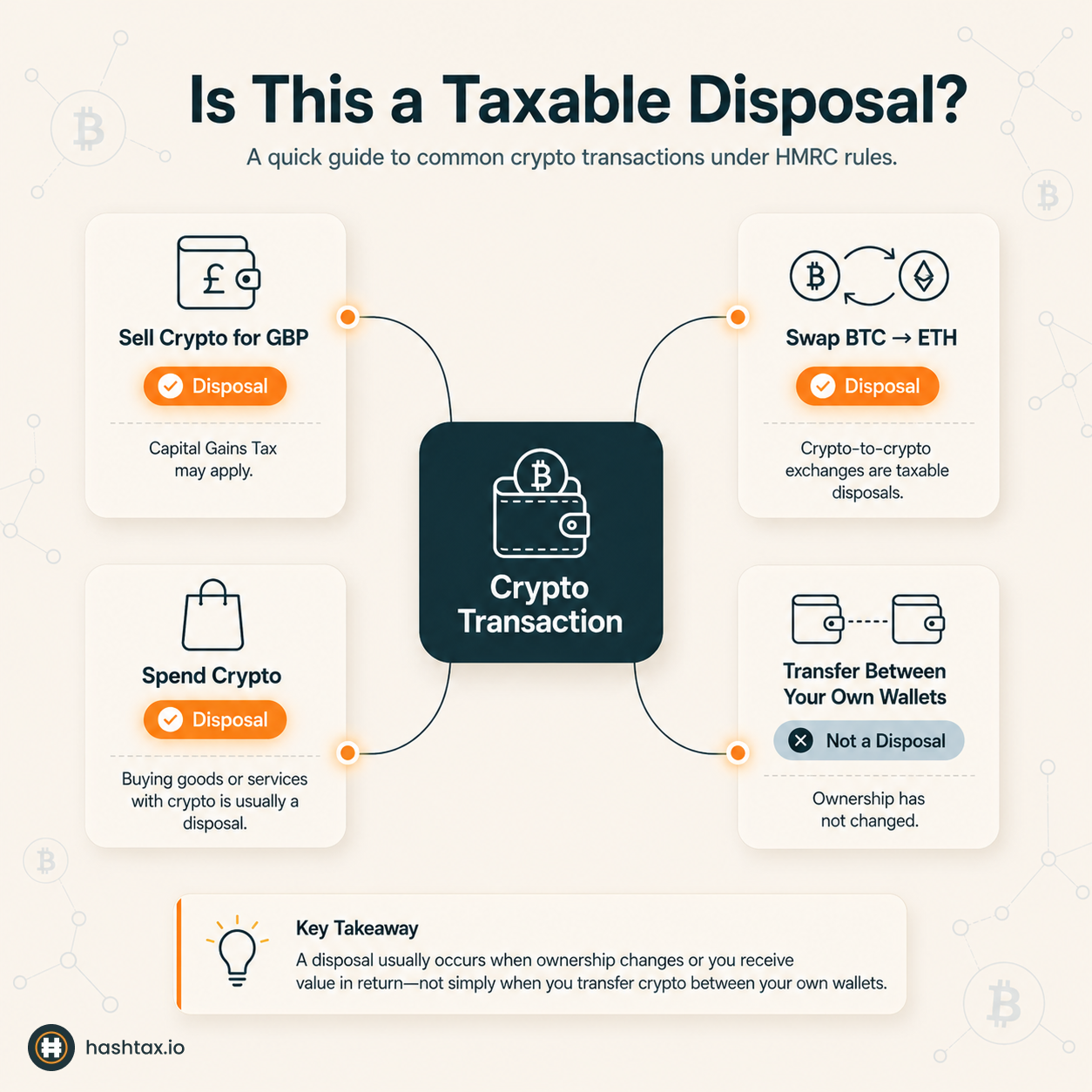
The core mistake is definitional. Many investors assume "disposal" means converting to fiat currency. HMRC's definition is far broader than that.
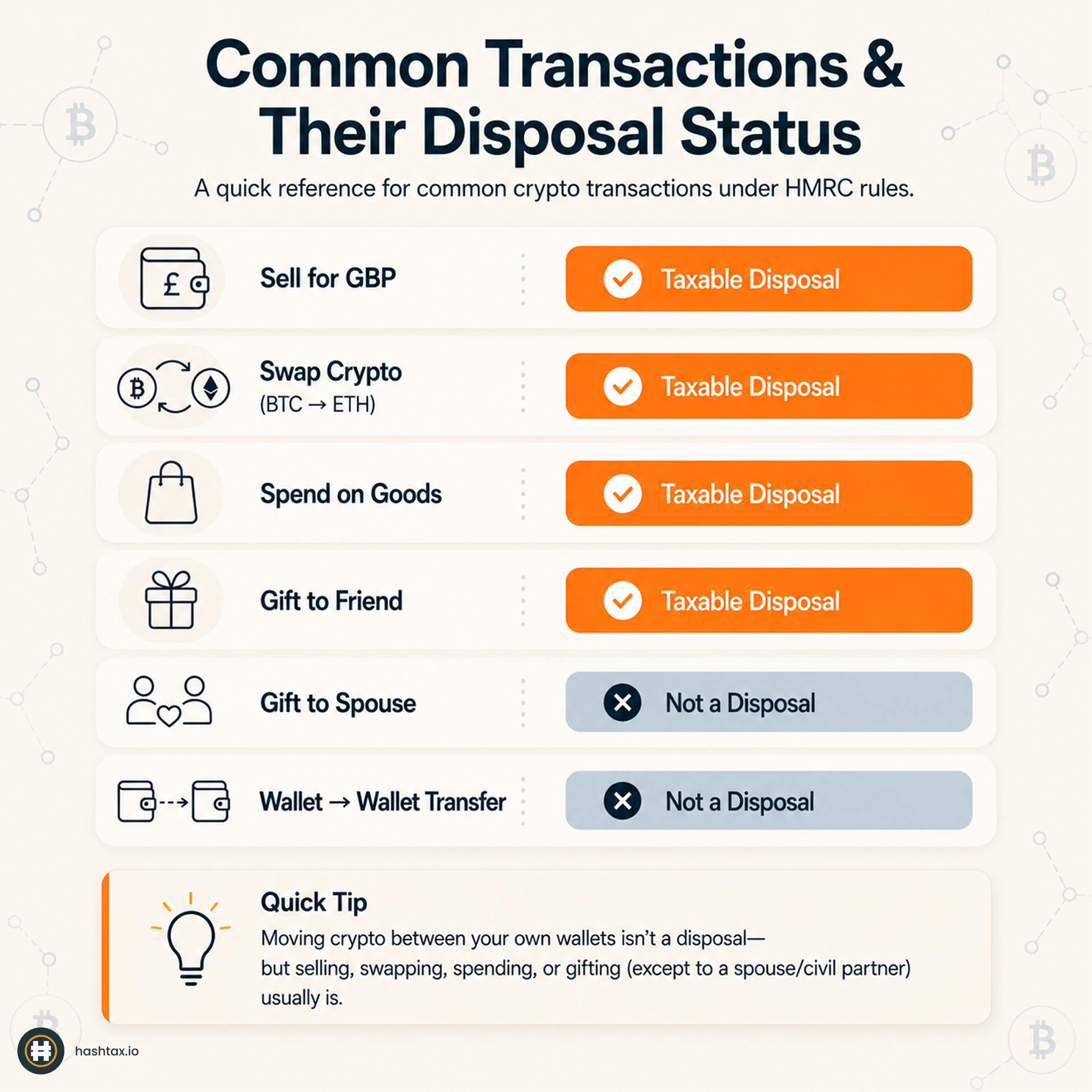
Under HMRC's Cryptoassets Manual, a disposal happens whenever you dispose of a beneficial interest in a cryptoasset. This includes:
A straightforward transfer between two wallets you own isn't a disposal, because beneficial ownership hasn't changed. But the moment BTC becomes ETH, ownership of the original asset has ended and a new asset has begun, and that's exactly what triggers Capital Gains Tax.
Financial Consequence: Say you bought Bitcoin for £2,000 and later swap it for Ethereum when that Bitcoin is worth £5,000. You've made a £3,000 gain, reportable and potentially taxable, even though you never sold anything for cash and the Ethereum is still sitting in your wallet.
HashTax Solution: We identify every swap across your full transaction history, not just the exchanges you remember, and reconcile each one against HMRC's disposal definition so nothing is missed or over-reported.
Once an investor accepts that a swap is a disposal, the next mistake usually follows quickly: miscalculating the gain because the cost basis rules haven't been applied correctly.
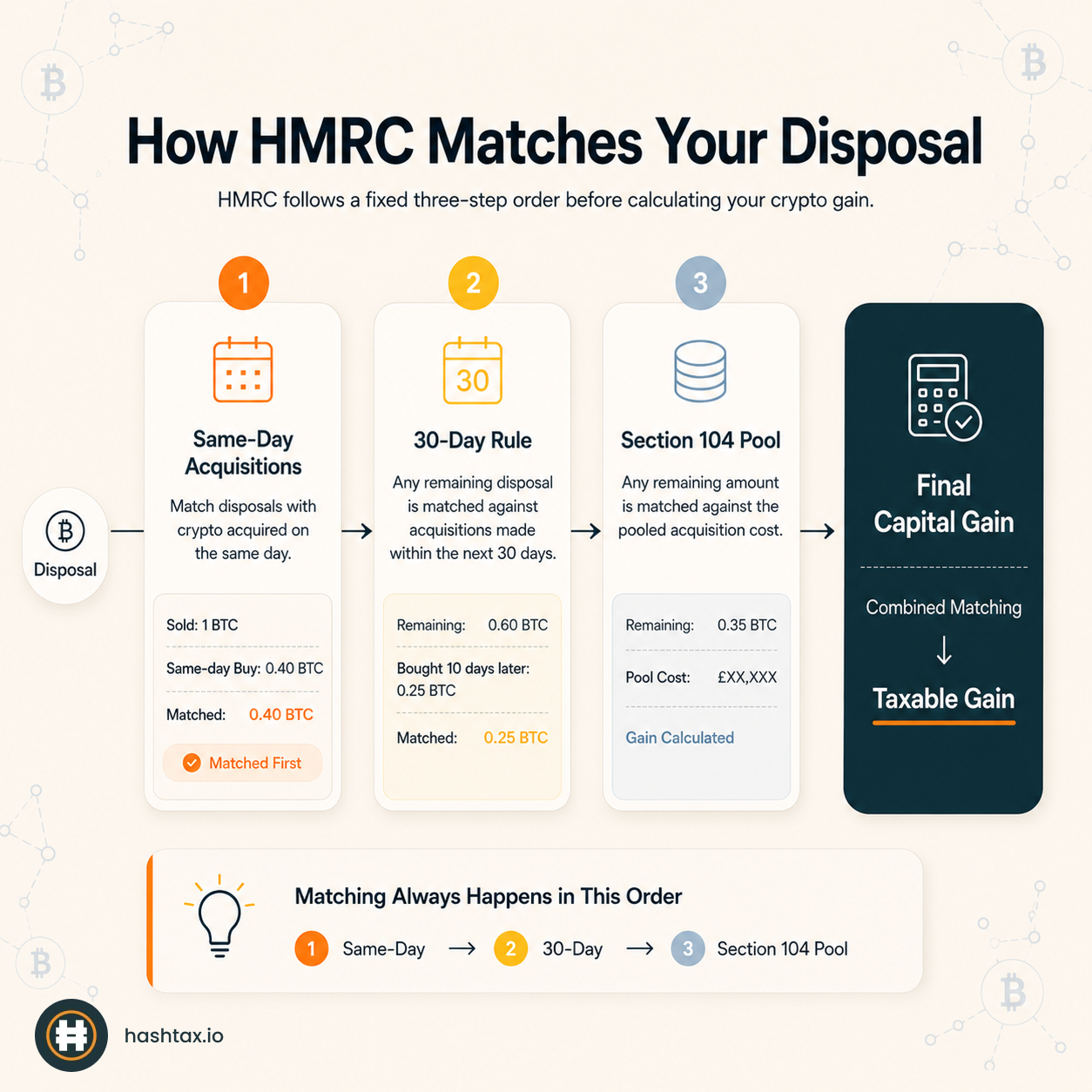
UK crypto holdings use Section 104 pooling. Every unit of the same cryptocurrency you own is added to a single pool, and your cost basis is the weighted average cost of everything in that pool, not the price you paid for the specific coins you happen to be swapping.
Two further rules can override standard pooling and catch investors out:
Financial Consequence: An investor who swaps out of a token and buys back into it within 30 days, a common pattern during active trading, cannot use their pooled average cost for that disposal. HMRC requires matching against the specific 30-day repurchase instead, which frequently produces a different, and often larger, taxable gain than expected.
HashTax Solution: Our specialists apply same-day and 30-day matching correctly across every wallet and exchange before falling back to Section 104 pooling, so your reported gain reflects HMRC's actual methodology rather than a simplified average.
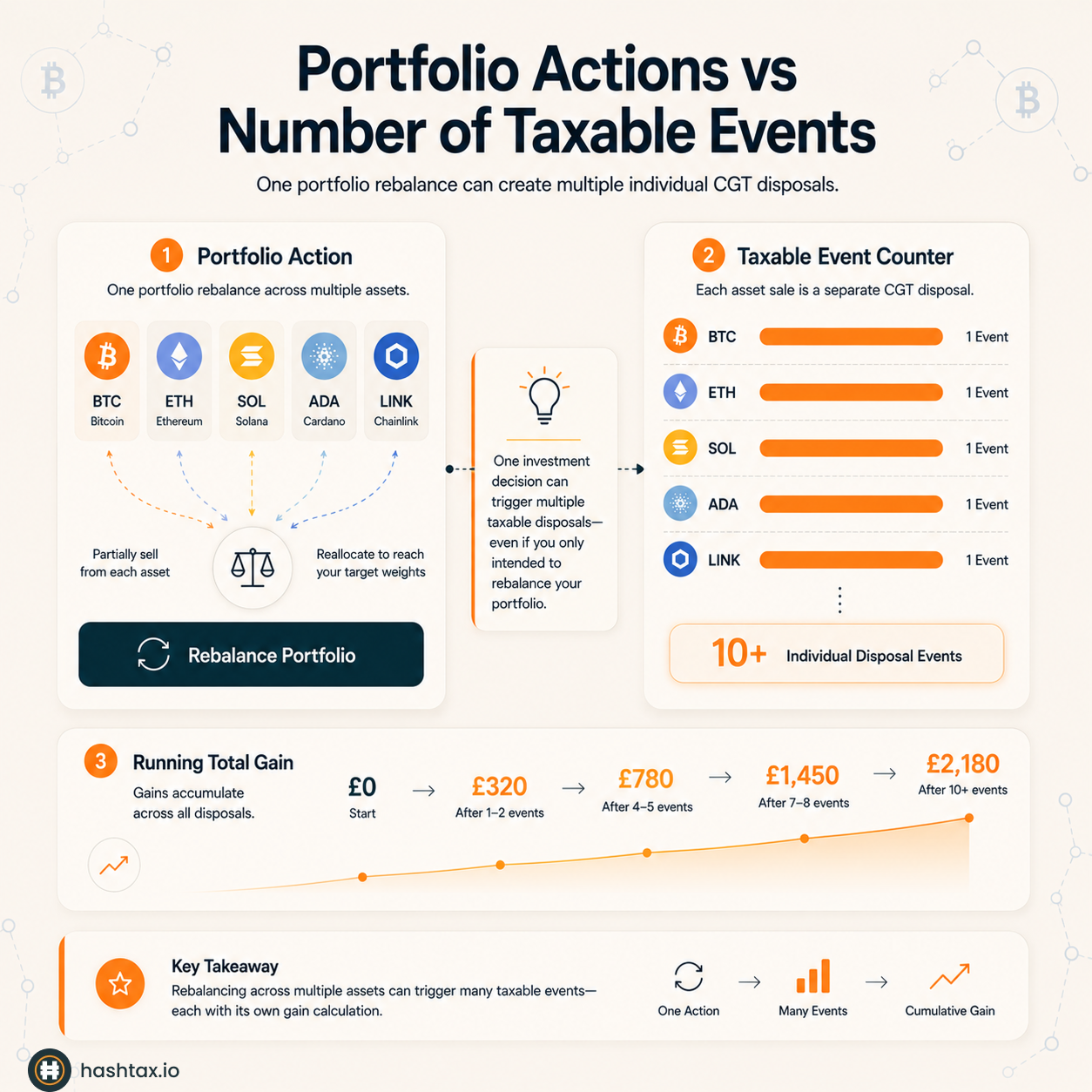
The third mistake is one of scale. Investors who rebalance a portfolio, chase a rotation between altcoins, or run a DeFi strategy involving multiple swaps rarely realise how many individual disposals they've created until they sit down to file.
A single "rebalance my portfolio" decision executed across five tokens can generate five, ten, or more separate CGT calculations in one afternoon. Each swap needs its own disposal proceeds, its own matched cost basis, and its own gain or loss figure.
This matters because the Crypto Trading Tax guide explains how transaction volume, not portfolio value, is what drives reporting complexity. A portfolio worth £15,000 with 40 swaps is more complex to report accurately than a £150,000 portfolio with two disposals a year.
Financial Consequence: Gains and losses across every swap in the tax year are aggregated before the £3,000 annual exempt amount is applied. Investors who track only their largest trades routinely miss smaller swaps that push their total gains over the threshold, or miss losses that would have reduced their tax bill.
HashTax Solution: We reconstruct your complete transaction history across every wallet and exchange used during the tax year, so every swap, large or small, is captured in the final calculation.
Our free Crypto Tax Health Check flags exactly this kind of gap in under two minutes, showing you whether your swap history is likely to contain unreported disposals before you file.
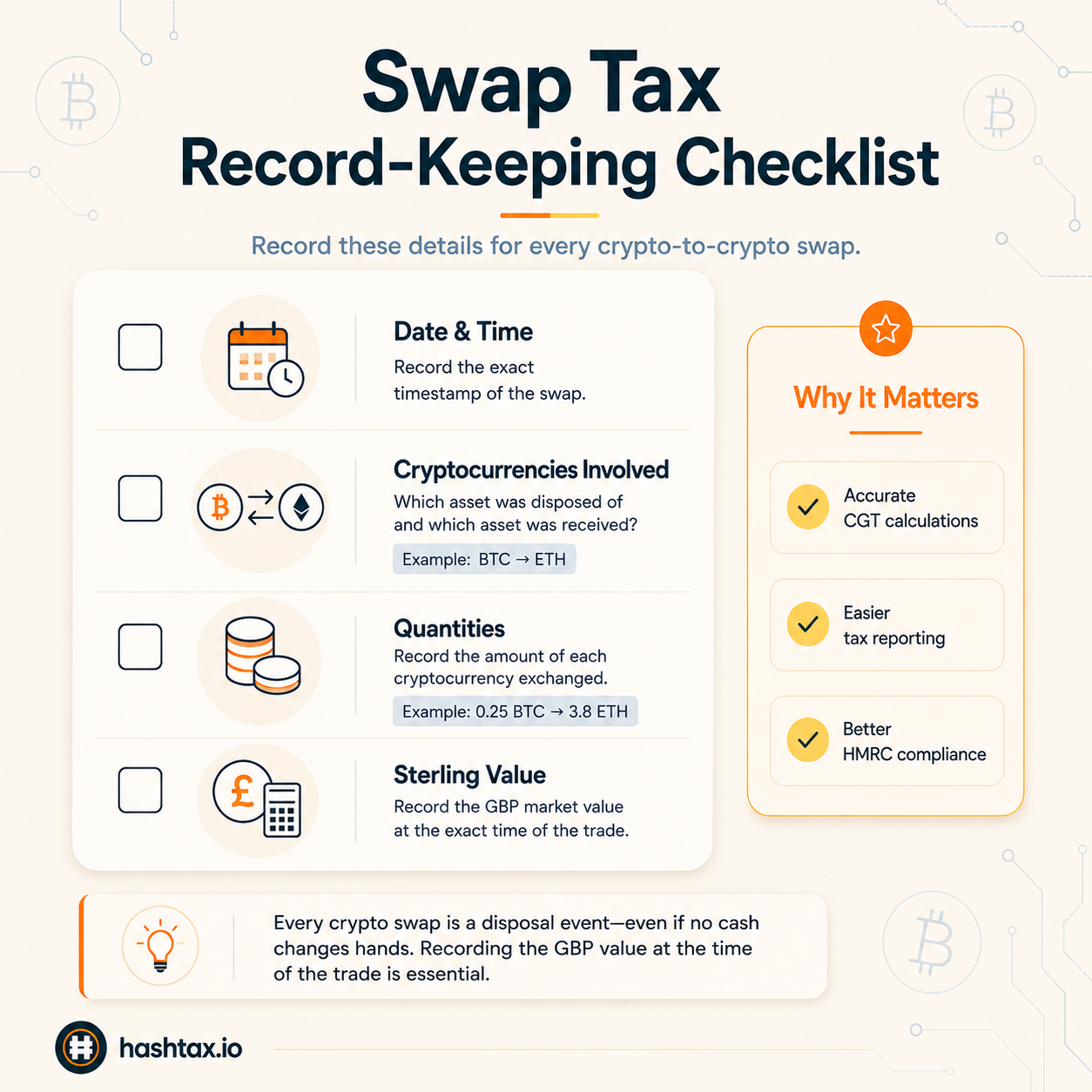
Avoiding this trap doesn't require giving up active trading or portfolio rebalancing. It requires a systematic approach to recording and reviewing swaps as they happen, rather than reconstructing them at filing time.
Step 1: Record every swap at the point of execution. Capture the date, both cryptocurrencies involved, the quantity of each, and the sterling value at the time of the transaction. Waiting until January to reconstruct months of swaps from memory or fragmented exchange exports is where most errors originate.
Step 2: Use a consistent, reasonable valuation method. HMRC expects a consistent approach to sterling valuation across all your disposals. Switching methods between transactions, or between tax years, creates inconsistencies that are difficult to defend if HMRC asks questions.
Step 3: Track your running annual exempt amount usage. With the exempt amount at £3,000 for the current tax year, knowing how much of it you've already used from earlier disposals helps you plan timing for later swaps rather than discovering the shortfall in April.
Step 4: Review your full swap history before filing, not during it. A dedicated review, ideally with several weeks before the Self Assessment deadline, gives you time to correct gaps, request missing exchange data, or seek professional input if the picture looks more complex than expected.
Following the same-day and 30-day matching rules manually across dozens of swaps is where DIY tracking most often breaks down. This is the point where professional review typically becomes worthwhile, not because the concept is difficult, but because the volume of matching calculations makes manual accuracy hard to guarantee.
All our work is delivered by qualified specialists. We are not an automated software platform. Every swap in your transaction history is reviewed by a specialist applying current HMRC guidance to your specific circumstances.
Not sure which service fits your situation? Start with the free Crypto Tax Health Check, or book a consultation directly to talk through your swap history with a specialist.
Free Compliance Assessment
Our Crypto Tax Health Check reviews your trading pattern and flags whether your crypto-to-crypto swaps are likely to contain unreported disposals. It takes about two minutes and there's no obligation to proceed further.
Three Paths Forward
Why Acting Now Matters
Unreported swap disposals don't disappear. They accumulate, along with any interest and penalties that apply once HMRC identifies the gap. Correcting your position proactively, before HMRC contacts you, is treated far more favourably than responding to an enquiry.
Get in Touch
Learn more about how we work on the HashTax homepage, or book your free consultation today. Your crypto tax compliance matters. Let's address it properly together.
Disclaimer: This article provides general information about UK cryptocurrency tax treatment of crypto-to-crypto swaps, current as of the 2025/26 tax year. Capital Gains Tax rates, the annual exempt amount, and HMRC guidance are subject to change, and individual circumstances vary. You should seek professional advice specific to your situation before making tax decisions. HashTax provides professional cryptocurrency tax services delivered by qualified specialists. We are not an automated software platform.
HashTax Specialists
Our team of ACCA-qualified accountants specializing in UK cryptocurrency taxation. We provide expert guidance on HMRC compliance, tax planning, and professional advisory services for crypto investors and businesses.

.svg)
.svg)