

DeFi users providing liquidity on protocols like Uniswap, Curve, or Aave often assume that moving tokens into a pool is simply repositioning their own assets, not a taxable event. Under HMRC's current guidance, that assumption is usually wrong, and it remains wrong for at least the next several months.
Every deposit into a liquidity pool, every reward claimed, and every withdrawal can carry its own Capital Gains Tax or Income Tax consequence, calculated separately. HMRC has spent several years reviewing whether this approach fits how DeFi actually works, and on 13 July 2026 it confirmed a significant reform. Depositing into qualifying lending and liquidity pool arrangements will be treated on a "no gain, no loss" basis, removing the disposal charge that currently applies simply for moving tokens into a protocol.
The important detail is timing. This reform is confirmed policy, not a proposal under consultation, but it isn't law yet either. It takes effect from 6 April 2027. Every transaction you make between now and that date is still assessed under the existing rules in full.
This article explains exactly how liquidity pools are taxed today, what HMRC's confirmed reform will change from April 2027, and what that means for your filing right now.
.png)
HMRC's current position, set out in its Cryptoassets Manual, treats a transfer into a DeFi arrangement as a disposal whenever beneficial ownership of the tokens changes. For most liquidity pool interactions, that threshold is met at multiple separate stages.
Depositing tokens into a pool. When you deposit a pair of tokens into an automated market maker, HMRC generally treats this as disposing of your original tokens in exchange for new LP (liquidity provider) tokens. This can trigger a Capital Gains Tax calculation on the deposit itself, before you've earned anything from the position. Industry stakeholders have described this as a "dry tax" charge, since it can create a tax bill on a paper movement of assets rather than on any profit actually realised.
Earning rewards. Trading fees distributed to liquidity providers, and any additional protocol incentive tokens paid on top, are typically treated as income at the point you receive or can access them. This is taxed at your Income Tax rate, separately from any capital gains on the underlying position.
Withdrawing liquidity. Removing your tokens from the pool is treated as a further disposal, this time of your LP tokens, followed by a reacquisition of the underlying assets you receive back. Any impermanent loss or gain relative to your original deposit factors directly into this calculation.
The table below summarises how each stage is currently treated.
.png)
HMRC has acknowledged that the current framework creates a genuine mismatch with how DeFi actually operates. Depositing tokens with the intention of getting the same type and quantity back later doesn't feel like disposing of an asset, yet under current rules it's treated exactly that way.
Following a Call for Evidence in July and August 2022 and a formal consultation running from 27 April to 22 June 2023, HMRC published its summary of responses at Budget 2025. It confirmed it was advancing a "no gain, no loss" (NGNL) direction on 12 February 2026, and on 13 July 2026 it published the full policy paper, amending the Taxation of Chargeable Gains Act 1992 to formally introduce the new treatment. HMRC estimates the change will affect around 700,000 individuals who engage in cryptoasset loan and liquidity pool transactions.
The confirmed rules cover three specific scenarios:
Two things are explicitly unchanged. Rewards and returns, including staking rewards, lending interest, and trading fees earned from a pool, continue to be taxed as income at the point of receipt, exactly as they are today. And the relief does not extend to outright token sales, disposals outside a qualifying DeFi arrangement, or swaps that represent a genuine change in economic exposure, such as trading one token for a fundamentally different one rather than simply moving the same asset in and out of a protocol.
A worked comparison makes the practical effect clearer. Under current rules, an investor depositing £10,000 of ETH into a single-asset lending protocol triggers a CGT calculation on that deposit itself, even though nothing has been sold and the investor still holds an equivalent economic position in ETH. If that ETH had risen in value since the investor first acquired it, the deposit alone could crystallise a taxable gain before a single penny of lending interest has been earned. From 6 April 2027, the same deposit into the same protocol would fall under no-gain, no-loss treatment, meaning no CGT event occurs at the point of deposit, and the tax position only crystallises when the investor eventually withdraws in a way that represents a genuine change in what they hold, or disposes of the asset outright. The lending interest itself remains taxable as income throughout, under both the current and future regimes.
It's also worth being precise about what "confirmed" means here. HMRC has published legislative text and a firm commencement date, which is a materially stronger position than the "under consultation" status this reform held for most of the past three years. But HMRC itself has said it is still refining the precise boundaries of which automated market maker arrangements qualify, with further technical guidance expected before the end of 2026. Final costing for the measure will also be certified by the Office for Budget Responsibility at a future fiscal event. Treat the direction of travel as settled, but treat the fine detail, particularly around edge-case AMM structures, as still being finalised.
.png)
The gap between "confirmed policy" and "in force" is where most compliance risk sits over the next several tax filing seasons. Investors who assume the reform already applies, or who relax their record-keeping now that a friendlier rule is on the way, are the group most exposed if HMRC opens an enquiry into current or recent activity.
If you're actively providing liquidity now: Every deposit, reward claim, and withdrawal in the current tax year, and in the 2026/27 tax year that runs up to 5 April 2027, needs to be tracked and reported under existing rules. The NGNL treatment does not apply retroactively. Transactions completed before 6 April 2027 are assessed exactly as they would have been if the reform had never been announced.
If you've been treating deposits as non-taxable: This is the highest-risk position under current guidance, and it becomes riskier, not safer, now that HMRC has published a formal policy paper confirming that deposits are disposals under the existing rules it is choosing to reform. HMRC's Cryptoasset Reporting Framework, live since 1 January 2026, gives HMRC direct visibility into transaction data from UK-facing platforms, making unreported disposal-level activity increasingly easy to identify. HMRC also reported sending almost 65,000 warning letters to suspected crypto tax evaders in the 2024/25 year alone, underlining that enforcement activity is intensifying in parallel with this relief, not easing off because of it.
If you're planning future DeFi activity around the April 2027 commencement date: It's reasonable to factor the confirmed reform into decisions about activity you haven't yet undertaken. Some investors may choose to defer new liquidity positions until after 6 April 2027 specifically to avoid a disposal charge on entry, though that decision should weigh the tax treatment against the underlying investment case, not the other way round. What isn't reasonable is applying the future rules to transactions that have already happened, or that will happen before the commencement date.
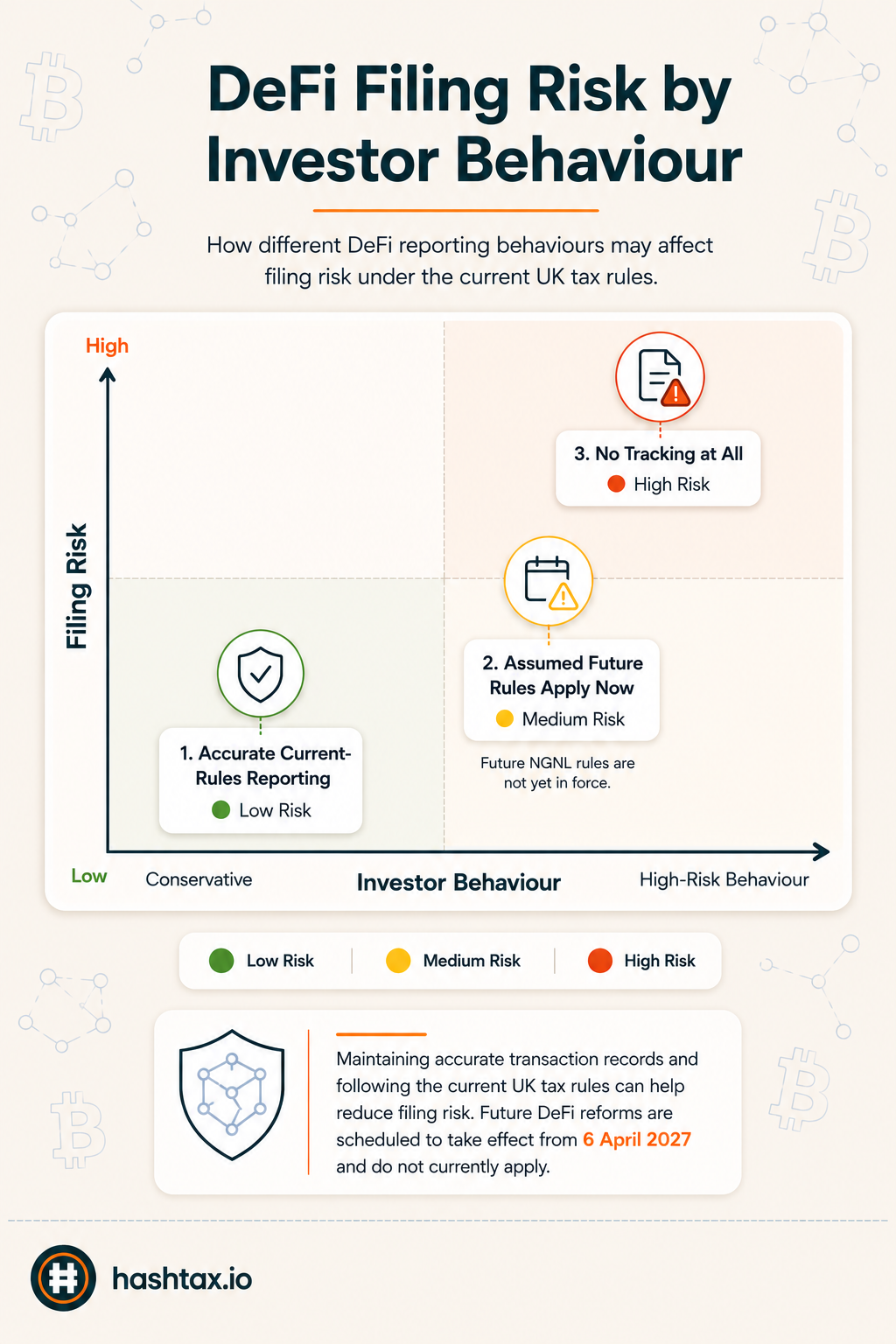
Having a confirmed commencement date is not a reason to relax compliance in the meantime. If anything, it's a reason to be more precise about which side of 6 April 2027 each of your transactions falls on, since that date will determine which set of rules applies to each disposal.
Step 1: Record every deposit and withdrawal at the token level. Note the specific tokens and quantities going in, the LP tokens received, and the specific tokens and quantities received back on exit, including any imbalance caused by impermanent loss.
Step 2: Separate reward income from capital movements. Trading fees, protocol incentive tokens, and staking rewards need their own income record, valued in sterling at the point of receipt, distinct from your capital gains tracking. This requirement doesn't change under the confirmed reform, so building the habit now carries forward directly.
Step 3: Apply current rules to every transaction dated before 6 April 2027. Report deposits and withdrawals as disposals under existing HMRC guidance for the whole of the current tax year and the 2026/27 tax year. Do not anticipate the NGNL treatment early, even where it seems likely to apply once it takes effect.
Step 4: Flag any position you intend to hold across the commencement date. A liquidity position opened before 6 April 2027 and closed afterwards will likely need to be assessed against both the old and new rules at different points in its life. Marking these positions now, rather than trying to reconstruct the boundary retrospectively, will make next year's filing considerably more straightforward.
Step 5: Watch for HMRC's further technical guidance on AMM boundaries. Because HMRC has said the precise scope of qualifying automated market maker arrangements is still being finalised, positions on newer or more unusual protocol designs may sit in a genuine grey area until that guidance is published, expected before the end of 2026.
All our work is delivered by qualified specialists. We are not an automated software platform. DeFi liquidity pool activity is one of the most complex areas of crypto tax, and our specialists apply current HMRC guidance transaction by transaction, not a generic approximation, while keeping a clear eye on which rules apply either side of the April 2027 commencement date.
Not sure how your liquidity pool activity should be reported under current rules, or how to plan around the April 2027 change? Start with the free Crypto Tax Health Check, or book a consultation to talk through your DeFi history with a specialist.
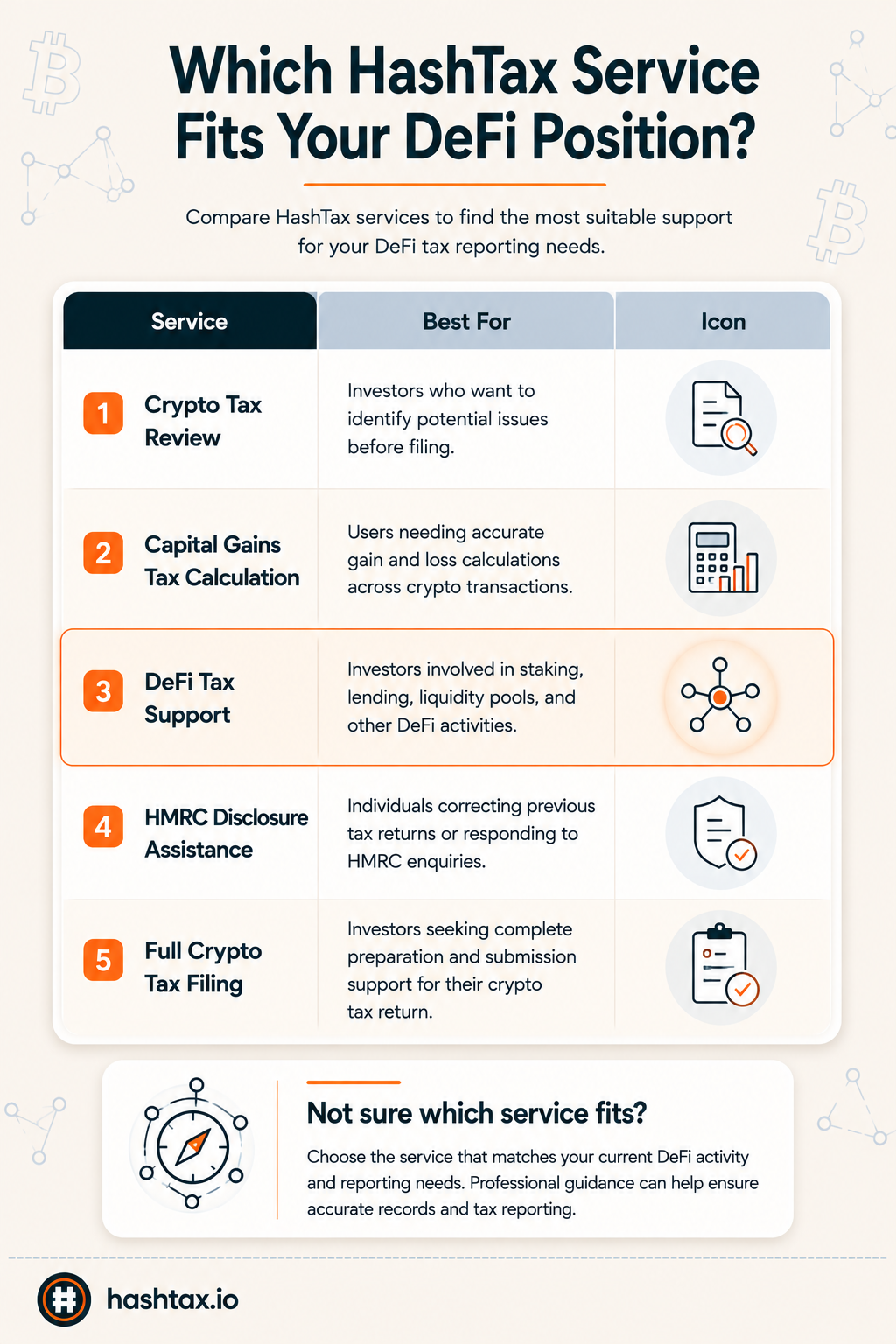
Our Crypto Tax Health Check reviews your trading pattern, including DeFi activity, and flags whether your liquidity pool reporting is likely to contain gaps under current HMRC rules. It takes about two minutes and there's no obligation to proceed further.
A confirmed future reform does not pause your current reporting obligations. Every deposit, reward, and withdrawal made before 6 April 2027 is assessed under today's rules, and correcting any gaps proactively remains far more favourable than waiting for HMRC to identify them first, particularly with CARF data now flowing directly from UK platforms.
Learn more about how we work on the HashTax homepage, or book your free consultation today. Your crypto tax compliance matters. Let's address it properly together.
Disclaimer: This article provides general information about the UK tax treatment of DeFi liquidity pools, current as of July 2026. HMRC confirmed a "no gain, no loss" reform for qualifying lending and liquidity pool arrangements on 13 July 2026, amending the Taxation of Chargeable Gains Act 1992, but this reform does not take legal effect until 6 April 2027, and further technical guidance on its precise scope is still expected. Until that date, existing HMRC guidance applies in full. Tax rates, thresholds, and HMRC guidance are subject to change, and individual circumstances vary. You should seek professional advice specific to your situation before making tax decisions. HashTax provides professional cryptocurrency tax services delivered by qualified specialists. We are not an automated software platform.
HashTax Specialists
Our team of ACCA-qualified accountants specializing in UK cryptocurrency taxation. We provide expert guidance on HMRC compliance, tax planning, and professional advisory services for crypto investors and businesses.

.svg)
.svg)