

A common assumption among UK businesses considering crypto payments is that accepting Bitcoin somehow sits outside the VAT system entirely. It doesn't. HMRC has treated cryptocurrency as a settled area of guidance since 2014, and the rules are clearer than most business owners expect, once the distinction between exchanging crypto and using it as payment is properly understood.
This article sets out exactly how VAT applies when you accept Bitcoin or other cryptocurrency for goods and services, how to account for that revenue correctly, and what changes if you hold the crypto rather than converting it immediately. Whether you're evaluating crypto payments for the first time or reviewing an existing setup, this covers everything you need in one place.
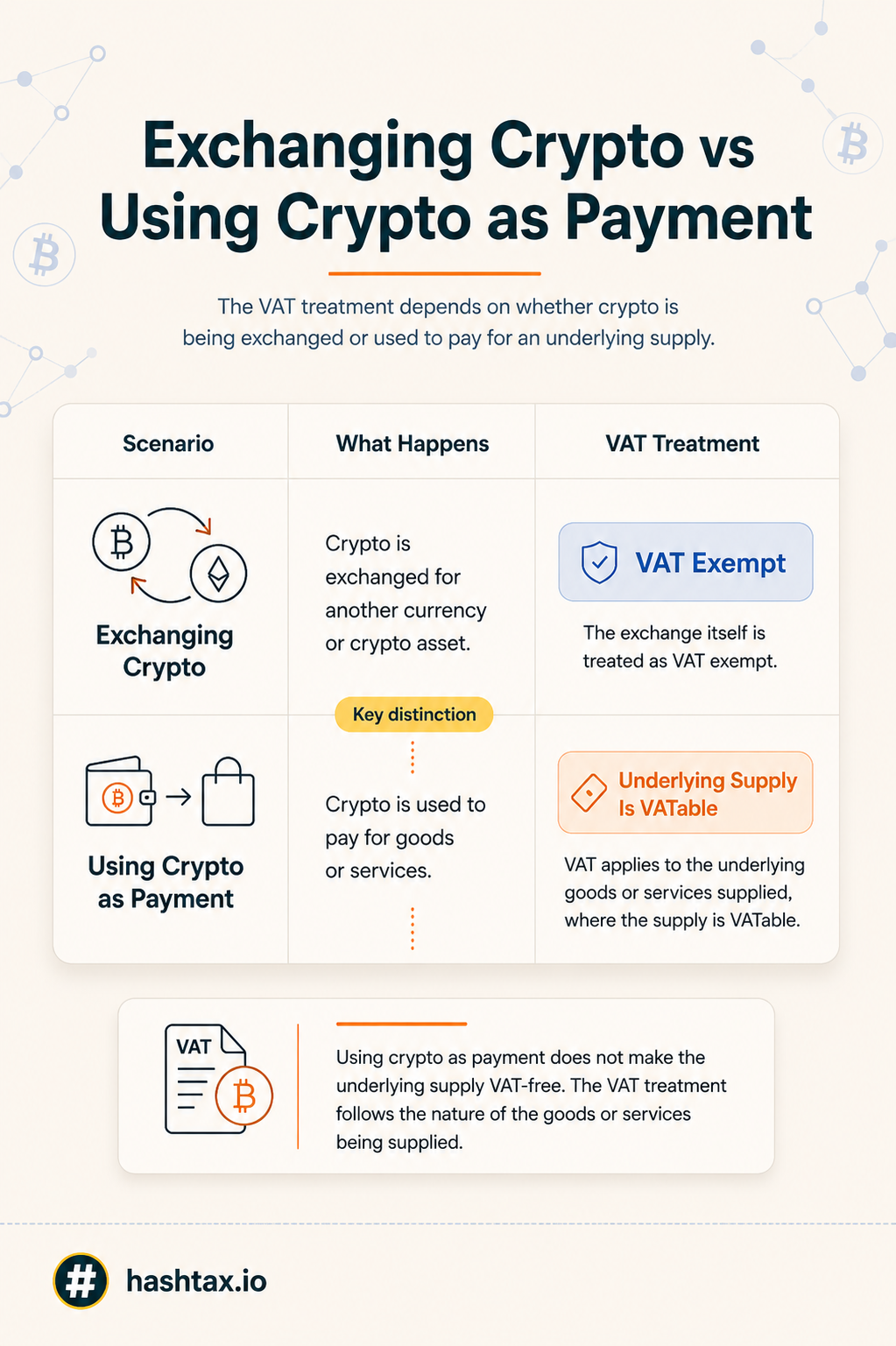
HMRC's position, set out in Revenue and Customs Brief 9/2014 and maintained since, treats cryptocurrency exchange activity as exempt from VAT, similar to other payment and financial services. This exemption is often misread as meaning crypto transactions generally sit outside VAT, which is not correct.
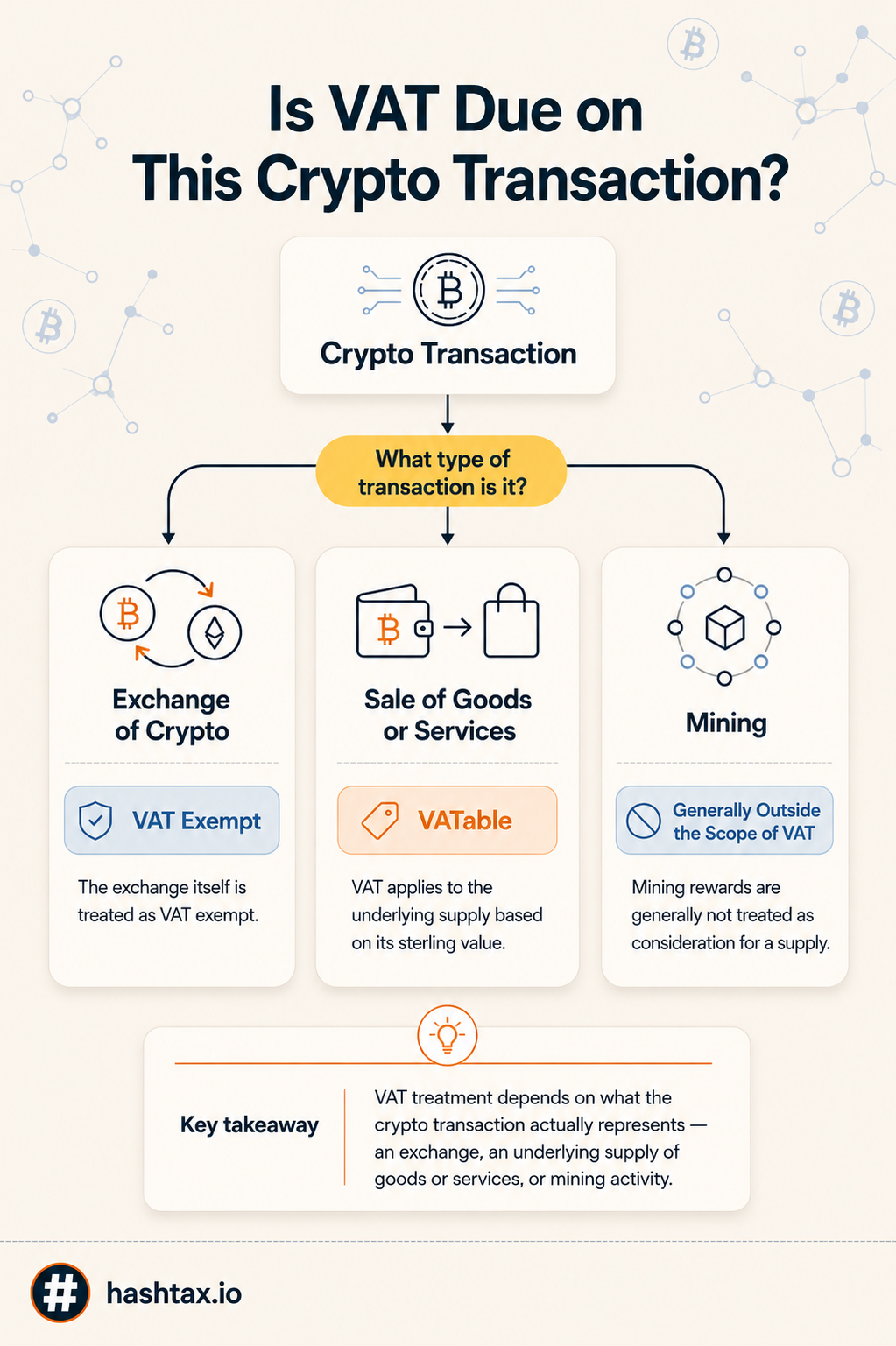
Exchanging crypto for sterling or another currency is exempt. No VAT is due on the value of the cryptocurrency itself when it's converted to or from fiat currency, and transaction charges made for arranging the exchange are also exempt.
Selling goods or services in exchange for crypto is fully VATable, as normal. If your business sells a product or service and the customer pays in Bitcoin, VAT is due in the normal way on that supply, exactly as if the customer had paid in pounds sterling. The rate that applies (standard, reduced, or zero-rated) depends entirely on what you're selling, not on how the customer paid for it.
Crypto mining income generally falls outside the scope of VAT. HMRC's guidance treats mining as lacking a sufficient direct link between the service provided and the consideration received, so this generally isn't relevant unless your business also mines cryptocurrency alongside accepting it as payment.
The value on which VAT is due is the sterling value of the cryptocurrency at the point the transaction takes place, not at the point you later convert it to fiat currency, if you convert it at all.
Accepting crypto payments doesn't change when or how you recognise revenue. HMRC's guidance is explicit that the normal rules for revenue recognition and taxable profit calculation continue to apply, with the crypto simply translated into sterling.
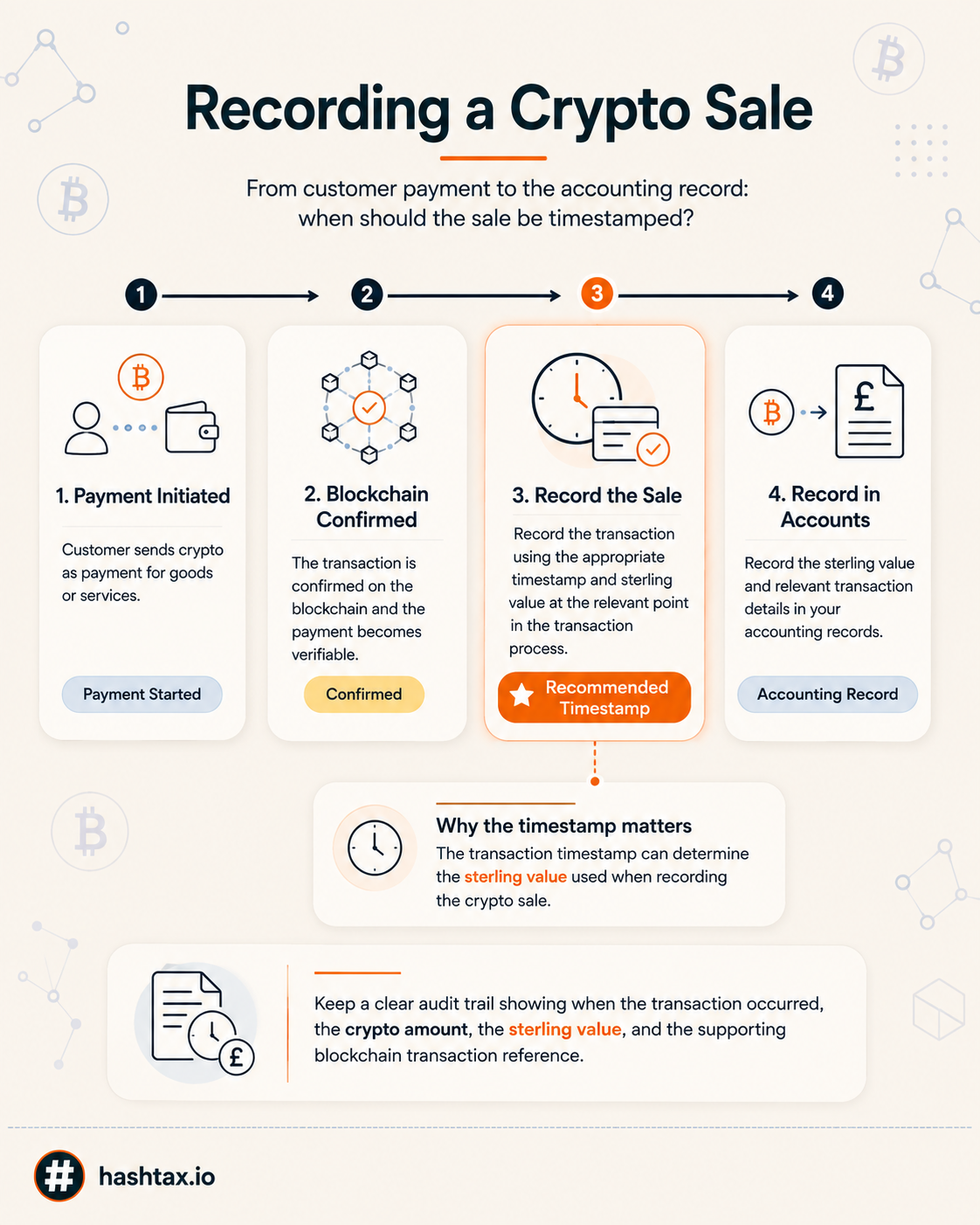
Step 1: Record the sterling value at the point of sale. This is the value used both for VAT purposes and for revenue recognition in your accounts, based on a reasonable and consistent exchange rate source applied at the transaction time.
Step 2: Use a consistent valuation methodology across every transaction. HMRC expects consistency rather than a specific mandated exchange rate source, but switching methods between transactions, or between tax years, creates inconsistencies that are difficult to defend if HMRC asks questions.
Step 3: Be aware of the timing gap between transaction initiation and blockchain confirmation. Bitcoin's price can move meaningfully between the moment a customer initiates payment and the moment it's confirmed on the blockchain. Decide upfront which timestamp your business uses, and apply it consistently.
Step 4: Reflect the sterling value in your accounting system as standard revenue. For a sole trader, this feeds through your normal Income Tax calculation. For a limited company, it feeds through Corporation Tax on trading profits in the usual way.
Recognising revenue at the point of sale is only the first step. If your business holds the crypto rather than converting it to sterling immediately, a second layer of tax treatment applies to whatever happens to that crypto next.
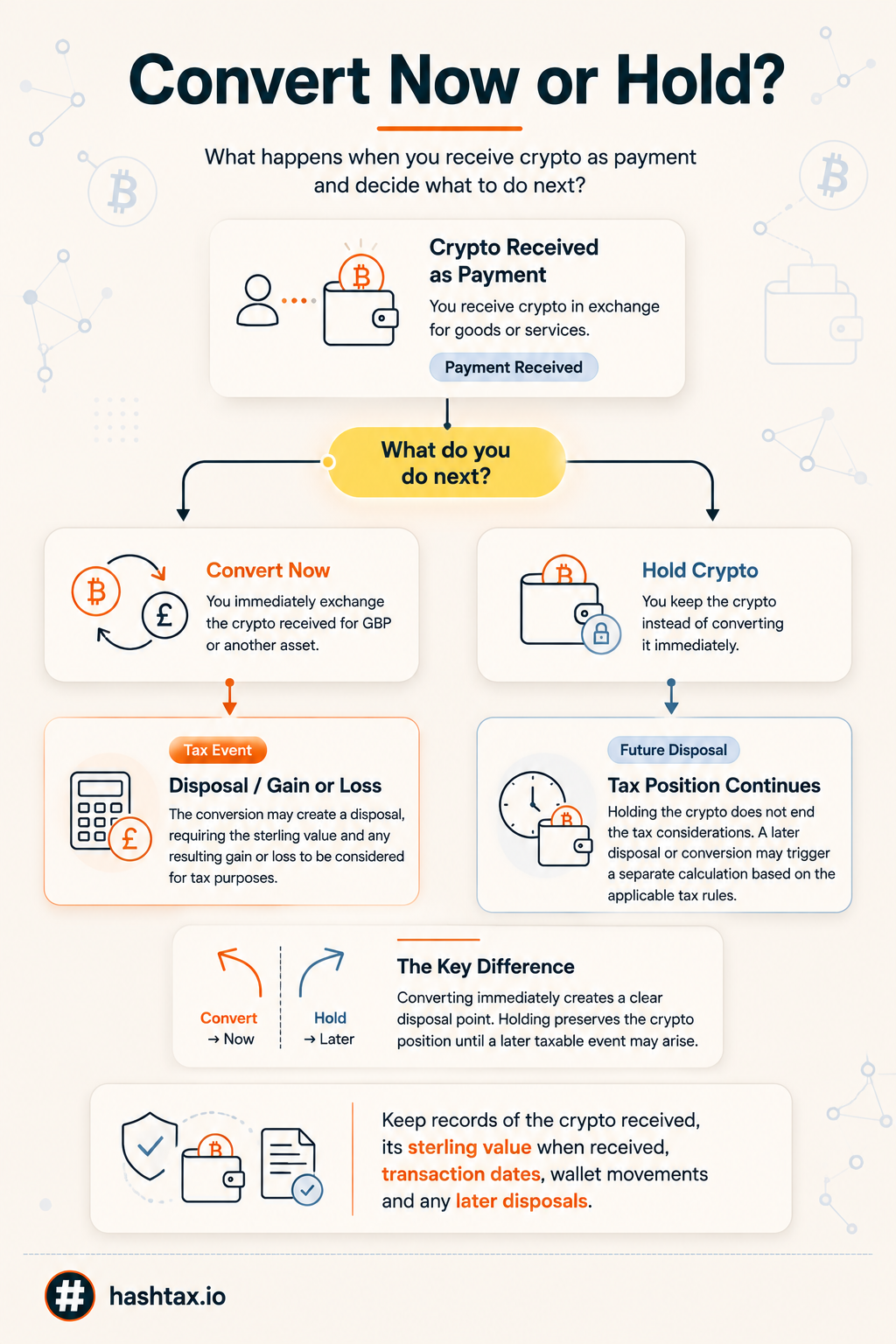
If you convert to sterling shortly after receipt: Any small movement in value between receipt and conversion is generally treated the same way ordinary foreign exchange movements would be, following normal forex-style rules for the underlying transaction.
If you hold the crypto for a longer period: The value movement while you hold it is a separate question from the original sale. Whether that movement is taxed as a trading profit or loss, or as a capital gain or loss, depends on whether the crypto sits on your balance sheet as trading stock or as an investment asset, and that classification should be documented clearly and applied consistently.
For limited companies specifically: Corporation Tax applies to both trading profits and chargeable gains at the same rates, since companies don't have a separate Capital Gains Tax regime or an annual tax-free allowance the way individuals do.
The decision to hold crypto received as payment, rather than converting it immediately, is a treasury and risk decision as much as a tax one, and it's worth making deliberately rather than by default.
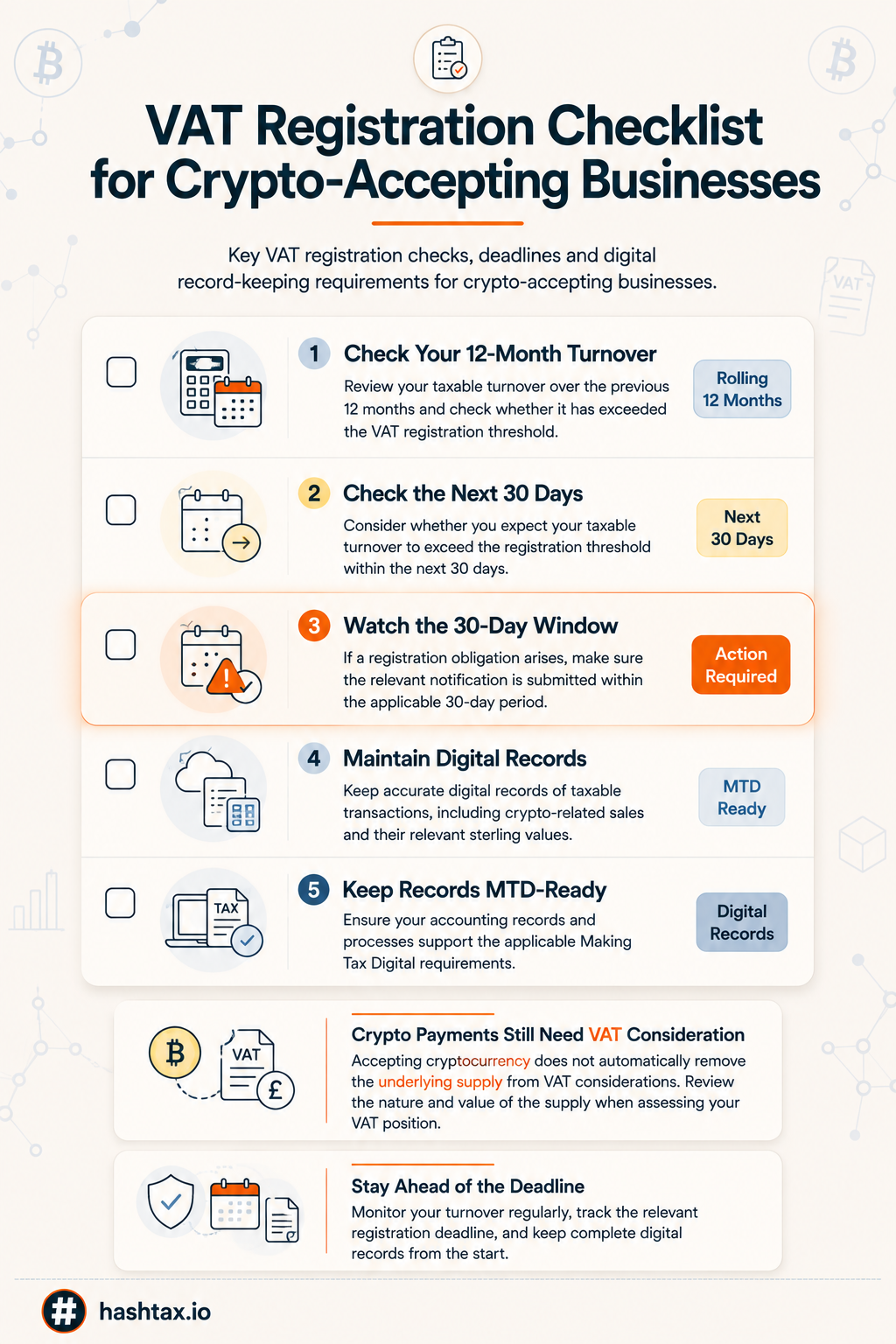
Accepting crypto payments doesn't create a separate VAT registration regime. The same £90,000 threshold applies, calculated on a rolling 12-month basis across all your taxable turnover, crypto and fiat combined.
Test 1: Look back over the previous 12 months. At the end of every month, add up your taxable turnover for the preceding 12 months, converting any crypto sales to their sterling value at the point of each transaction. If the total exceeds £90,000, you must notify HMRC within 30 days.
Test 2: Look forward 30 days. If you have reasonable grounds to believe your taxable turnover will exceed £90,000 in the next 30 days alone, for example from a large one-off crypto-paid contract, you must register immediately rather than waiting for the rolling 12-month test to catch up.
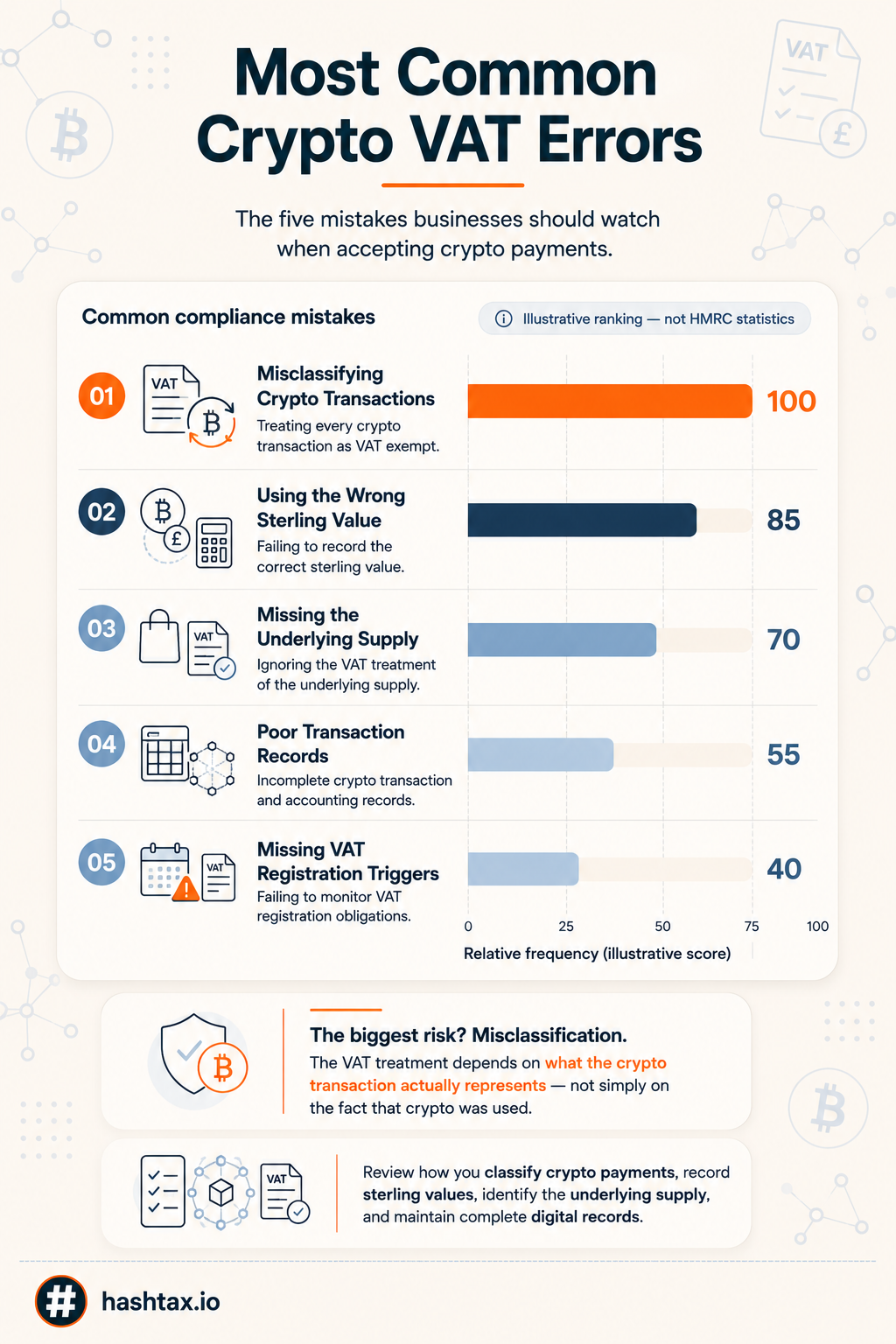
A common point of confusion is assuming that because crypto exchange activity is VAT-exempt, crypto sales revenue doesn't count toward the registration threshold. It does. The exemption applies to exchanging crypto for currency, not to the underlying sale of goods or services that happened to be paid for in crypto.
Once registered, quarterly VAT returns are required under Making Tax Digital, using digital record-keeping that accurately reflects the sterling value of every crypto-paid transaction.
Most VAT and accounting errors in this area come from a small number of recurring misunderstandings, rather than genuinely unclear rules.
All our work is delivered by qualified specialists. We are not an automated software platform. Every business we work with gets a review built around your specific payment flows, revenue recognition needs, and treasury decisions.
Not sure where your business's crypto payment setup stands? Book a consultation to talk through your VAT and accounting position with a specialist.
Free Compliance Assessment
We review your current or planned crypto payment setup, including VAT registration status, revenue recognition approach, and treasury decisions, and flag where your position may need correcting. There's no obligation to proceed further.
Three Paths Forward
Why Acting Now Matters
Getting revenue recognition and VAT treatment right from the first transaction is far simpler than correcting a backlog of inconsistently valued crypto sales later. Every month of unclear treatment adds transactions that will eventually need reconstructing.
Get in Touch
Learn more about how we work on the HashTax homepage, or book your free consultation today. Your crypto tax compliance matters. Let's address it properly together.
Disclaimer: This article provides general information about UK VAT and accounting treatment of crypto payments accepted by businesses, current as of mid-2026. VAT thresholds, Corporation Tax rates, and HMRC guidance are subject to change, and individual circumstances vary significantly. You should seek professional advice specific to your situation before making accounting or tax decisions. HashTax provides professional cryptocurrency tax services delivered by qualified specialists. We are not an automated software platform.
HashTax Specialists
Our team of ACCA-qualified accountants specializing in UK cryptocurrency taxation. We provide expert guidance on HMRC compliance, tax planning, and professional advisory services for crypto investors and businesses.

.svg)
.svg)