

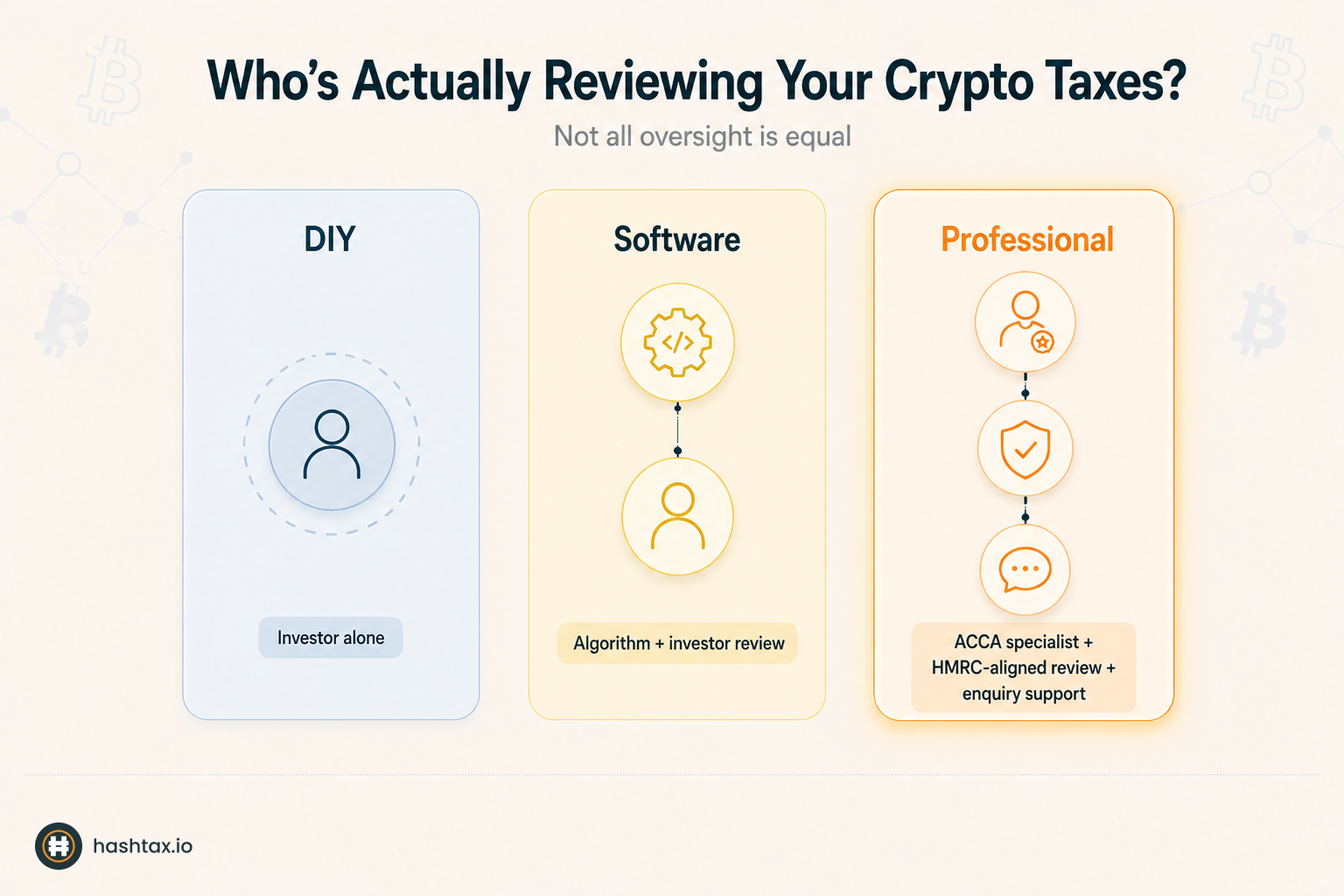
Every UK investor with cryptocurrency activity faces the same decision: handle your own tax position, use software, or work with a professional crypto tax accountant. The approach you choose has direct consequences for your HMRC compliance and the accuracy of your Self Assessment return.
HMRC's oversight of cryptocurrency has expanded significantly. The volume of HMRC guidance on digital assets, the exchange of data between HMRC and crypto platforms, and the increased scrutiny applied to Self Assessment returns involving crypto activity all point in the same direction. Getting this wrong carries real regulatory risk.
This article sets out what each approach actually involves, where each one fails, and why the evidence consistently points toward professional crypto tax services as the only approach that reliably delivers HMRC-compliant outcomes.
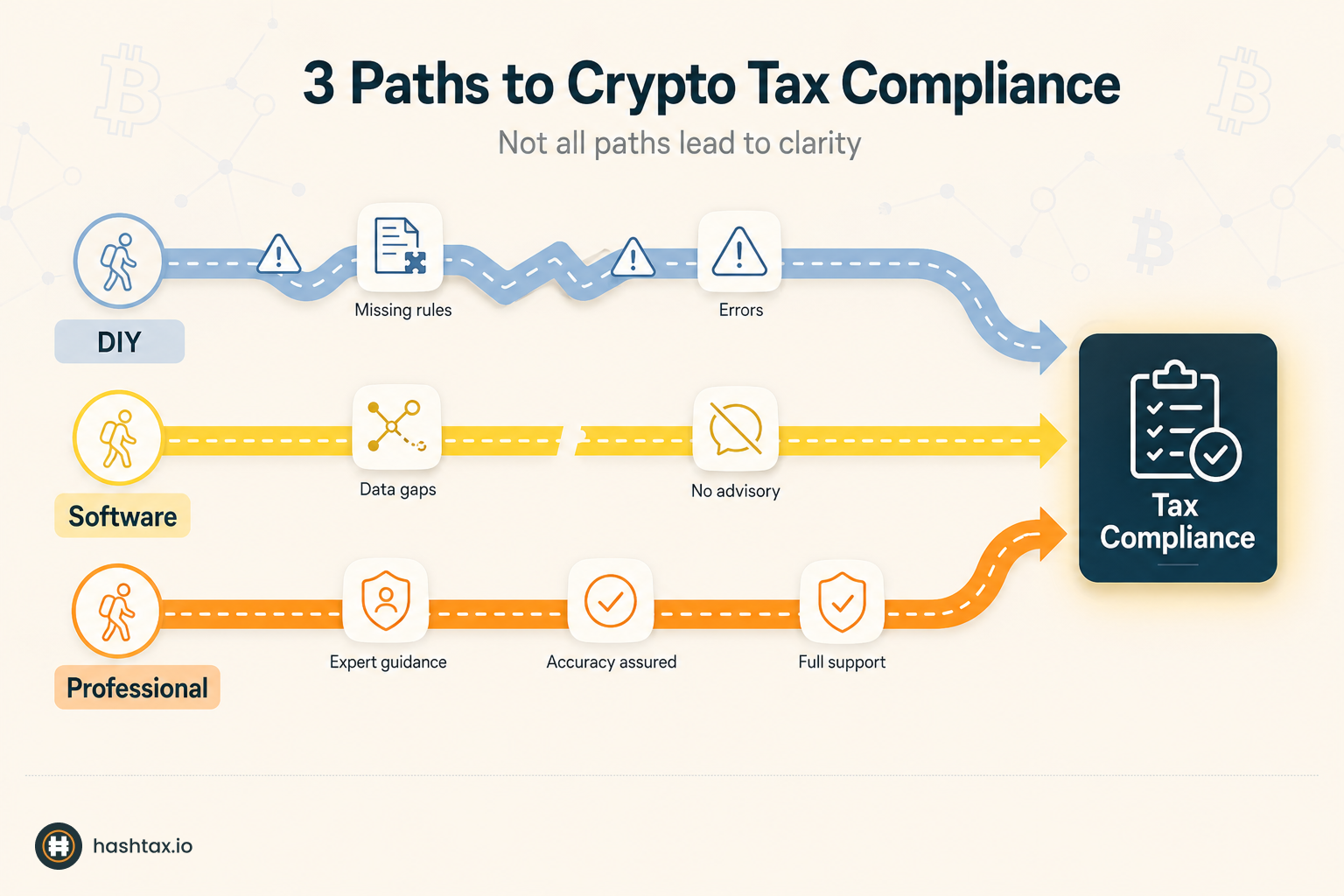
DIY crypto tax means calculating your own gains, losses, and income figures using HMRC guidance and submitting your Self Assessment return without professional review. You are responsible for correctly applying:
HMRC's rules for cryptocurrency are not straightforward. The identification rules interact in non-obvious ways, and the treatment of specific transaction types — DeFi protocols, cross-chain transfers, wrapped tokens — is not fully addressed in any single piece of HMRC guidance.
A DIY approach requires you to research evolving HMRC guidance, apply complex identification rules to every transaction, and make judgement calls where guidance is ambiguous. Errors in any of these areas produce a return that does not reflect your actual tax position.
There is no professional accountability attached to a self-prepared return. If HMRC opens an enquiry, you bear the full burden of defending your calculations without specialist support.
DIY is viable for investors with a small number of straightforward transactions, no DeFi activity, a single exchange, and a clear record of cost basis for every asset. Outside those conditions, the risk of material error increases significantly.
If your situation involves more than a handful of transactions, use the Crypto Tax Health Check to understand where your compliance gaps are before attempting a self-prepared return.
Crypto tax software platforms aggregate transaction data from connected exchanges and wallets, apply automated calculations, and produce a tax report. The output is intended to show your capital gains and income figures for a given tax year.
The appeal is speed and apparent simplicity. You connect your accounts, run a report, and transfer figures to your Self Assessment return.
Automated software relies entirely on the quality and completeness of the data fed into it. Several categories of transaction commonly cause problems:
Software produces a report. It does not review that report. An incorrect output submitted to HMRC is your responsibility, regardless of which platform generated it.
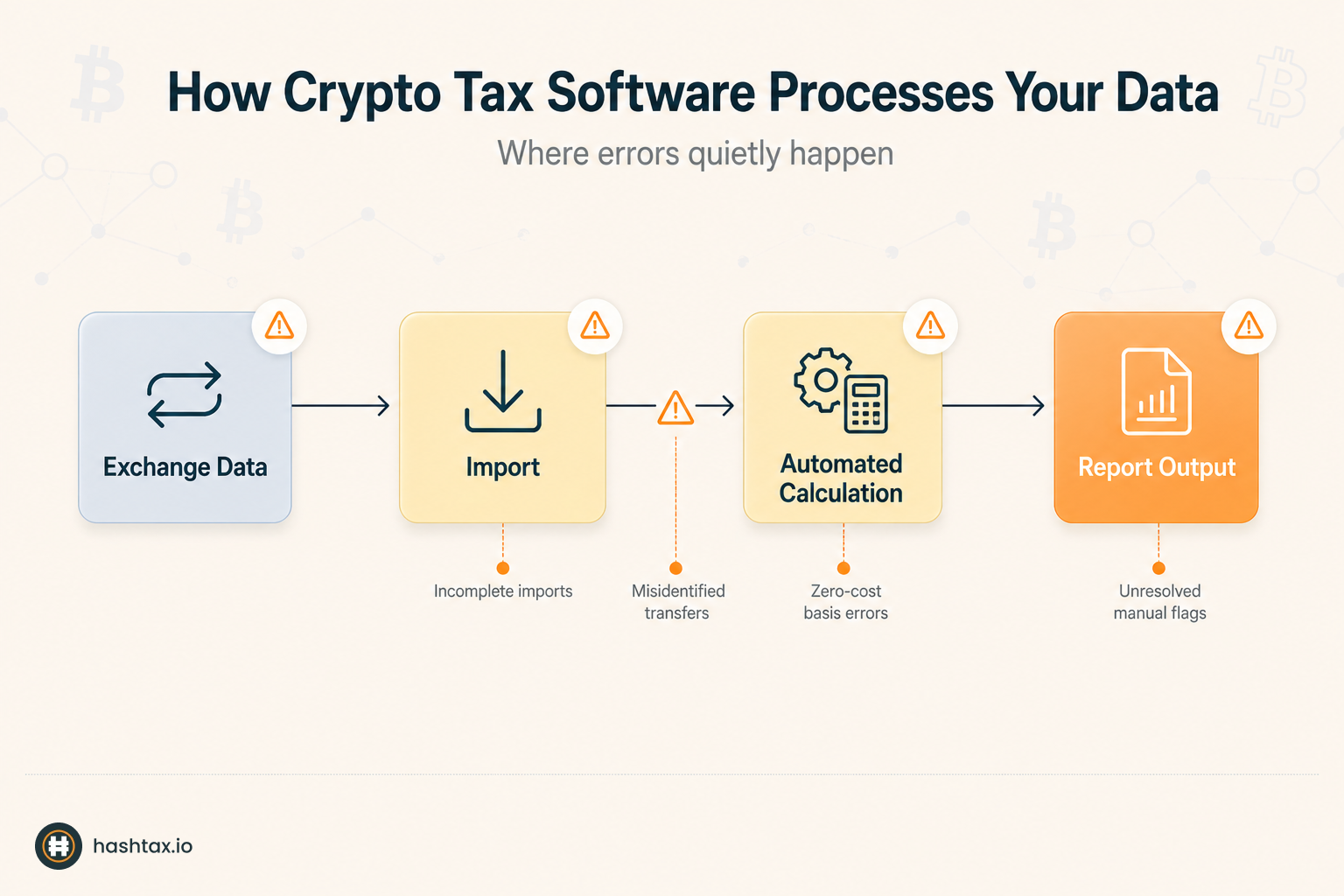
A software-generated report cannot verify itself. Confirming the output is accurate requires someone with sufficient technical knowledge to assess each flagged transaction, review the identification rule application, and check that all transfers are correctly categorised. That verification is a specialist task.
For straightforward portfolios, software may produce an accurate report. For anyone with meaningful complexity — multiple platforms, DeFi activity, high transaction volume, or gaps in historical records — the output requires professional review before it is HMRC-defensible.
Use the Tax Complexity Score to assess whether your situation falls into the range where software output alone is sufficient.
Working with an HMRC crypto tax specialist means your tax position is reviewed and prepared by a qualified professional with specific expertise in cryptocurrency. At HashTax, all work is carried out by ACCA-registered specialists operating under HMRC supervision — not by automated software.
A professional engagement covers the full picture:
Crypto tax rules require judgement, not just calculation. When HMRC guidance does not directly address a transaction type — and there are many where it does not — a qualified specialist applies professional judgement informed by HMRC's published principles, case law, and current practice. That judgement cannot be replicated by an algorithm.
Professional review also provides accountability. A HMRC crypto tax specialist who prepares your return stands behind their work. If HMRC enquires, you have professional representation from someone who knows the detail of your position.
The combination of technical expertise, identification rule accuracy, and professional accountability is what separates a professionally prepared return from any other approach.
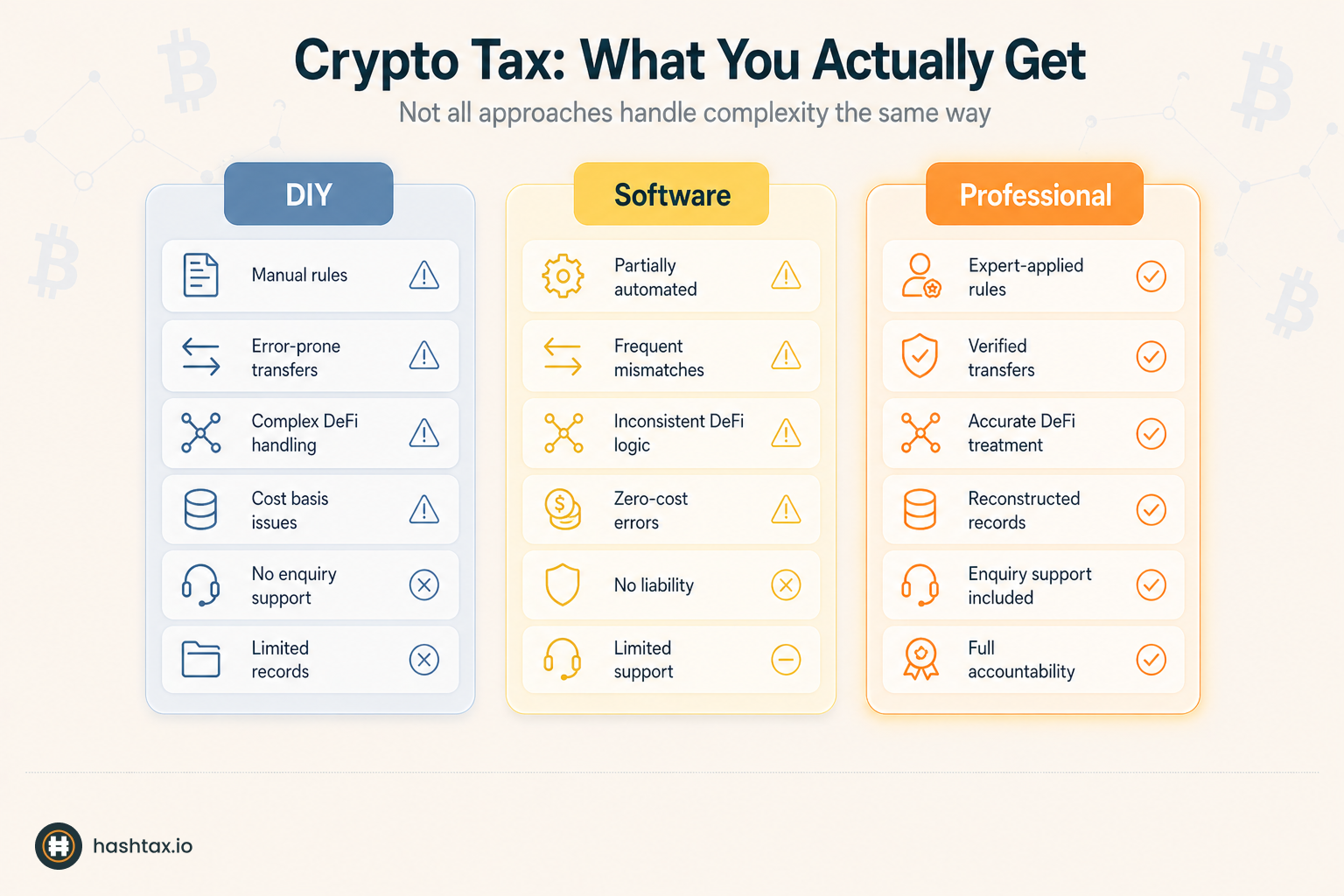
The honest answer is that the right approach depends on the complexity of your crypto activity. For investors with a very small number of transactions, a single exchange, no DeFi involvement, and complete cost basis records, DIY or a software report may be sufficient.
For everyone else, the question is not whether professional crypto tax services are worth the cost. The question is whether the risk of an inaccurate Self Assessment return — and the potential for HMRC penalties, interest, and an enquiry — is acceptable.
Several factors indicate professional review is the appropriate route:
If any of these apply, complete the Crypto Tax Health Check for a structured assessment of your compliance position.
All HashTax services are delivered by qualified specialists — we are not an automated software platform. Every engagement involves human expert review of your transaction history, correct application of HMRC identification rules, and HMRC-compliant reporting prepared under ACCA professional standards.
Book a free consultation with a HashTax specialist
A HashTax specialist will review your crypto activity and identify the approach that addresses your compliance position correctly. We will confirm which aspects of your history require professional attention and advise on the most efficient path to a compliant return. There is no obligation to proceed.
Book your free compliance assessment
Path 1 — Immediate: If you have received an HMRC communication or your filing deadline is approaching, book an urgent consultation with a HashTax specialist now.
Path 2 — Scheduled: If you want to understand your position before the next Self Assessment deadline, complete the Crypto Tax Health Check as a starting point.
Path 3 — Self-Assessment: If you are still assessing your complexity level, use the Tax Complexity Score to determine whether professional review is needed.
HMRC interest and late-filing penalties accumulate from the date tax was due, not from when an enquiry opens. A compliance gap that exists today will cost more to resolve next year than it does to address now.
Visit HashTax to learn more about our professional crypto tax services, or book a consultation to speak directly with an HMRC crypto tax specialist about your situation.
Your crypto tax compliance matters. Let's address it properly together.
HashTax Specialists
Our team of ACCA-qualified accountants specializing in UK cryptocurrency taxation. We provide expert guidance on HMRC compliance, tax planning, and professional advisory services for crypto investors and businesses.

.svg)
.svg)